
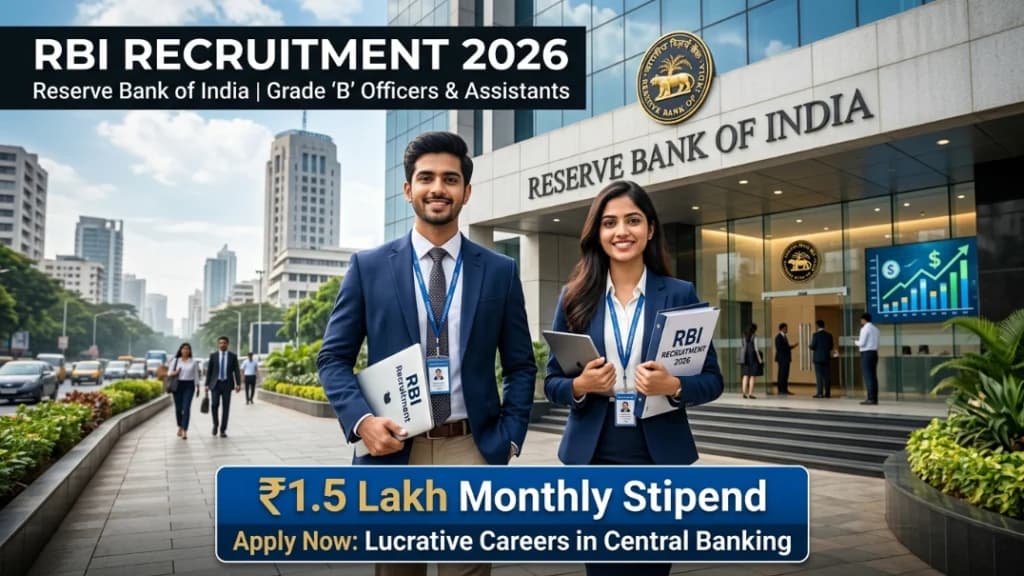
The Reserve Bank of India has once again opened doors for talented young graduates and postgraduates across the country through its prestigious RBI Recruitment 2026 drive under the Young Professionals Programme. This time, the opportunity is turning heads — and for good reason. With a monthly stipend of ₹1.5 lakh, this engagement is not just a job; it is an immersive professional experience inside one of the most powerful financial institutions in Asia. If you have been eyeing a meaningful entry into the world of central banking, monetary policy, and financial regulation, this could be the defining moment of your career.
Applications are currently being accepted online, and the last date is approaching fast. Candidates who delay risk missing out on one of the most competitive yet rewarding short-term professional opportunities available in India’s government and banking sector right now.
Quick Answer — What Is RBI Recruitment 2026?
RBI Recruitment 2026 refers to the Reserve Bank of India’s Young Professionals Programme, which invites qualified graduates and postgraduates in Economics, Finance, Statistics, and related disciplines to work alongside RBI’s expert teams. Selected candidates receive a monthly stipend of ₹1.5 lakh for a fixed engagement period. Applications are submitted online through the official RBI website. The last date is as per the official notification — apply immediately to avoid missing out.
RBI Recruitment 2026 — Complete Overview at a Glance
| Details | Information |
|---|---|
| Organization | Reserve Bank of India (RBI) |
| Recruitment Programme | Young Professionals Programme (YPP) 2026 |
| Post Name | Young Professional |
| Total Vacancies | As per official notification (limited seats) |
| Monthly Stipend | ₹1,50,000 (₹1.5 Lakh) |
| Educational Qualification | Postgraduate / PhD in Economics, Finance, Statistics & related |
| Age Limit | Up to 32 years (General Category) |
| Mode of Engagement | Fixed-term contractual (typically 2 years) |
| Application Mode | Online — rbi.org.in |
| Application Start Date | As per official notification |
| Last Date to Apply | As per official notification — Apply Immediately |
| Selection Process | Application Screening → Interview → Medical (if applicable) |
| Official Website | rbi.org.in |
⚠️ Candidates must verify all dates and details from the official RBI notification at rbi.org.in before applying. Data above is based on available official information.
About the RBI Young Professionals Programme — What Makes It Different?
Most government job seekers are familiar with RBI Grade B Officers or RBI Assistants. The Young Professionals Programme, however, is an entirely different kind of opportunity — and in many ways, a more intellectually stimulating one.
The programme was designed with a clear objective: to bring in domain specialists from academia and the private sector who can contribute fresh, research-backed thinking to RBI’s core functions. Unlike a regular permanent recruitment, this is a knowledge partnership — you come in as an expert, work on live policy and research challenges, and leave with an experience that most professionals spend decades trying to build.
What Kind of Work Will You Do?
Selected Young Professionals are typically placed in departments dealing with monetary policy analysis, financial stability assessments, economic research, currency management, and financial market regulation. You are not a trainee here — you are expected to bring expertise and contribute meaningfully from day one.
What Are the Key Benefits?
- A ₹1.5 lakh per month stipend — competitive even against senior private sector roles
- Exposure to India’s top economists, policy makers, and financial regulators
- Access to RBI’s vast internal research database and intellectual ecosystem
- A credential on your resume that signals serious expertise in macroeconomics and public finance
- Opportunity to contribute to research publications, policy documents, and white papers
- For PhD scholars and postgraduate researchers, this can be a career-defining professional milestone
The programme essentially bridges the gap between academic knowledge and real-world policy making. That is what makes RBI Recruitment 2026 under YPP genuinely unique.
RBI Recruitment 2026 — Important Dates
| Event | Date / Status |
|---|---|
| Official Notification Release | As per RBI notification |
| Online Application Window Opens | As per official announcement |
| Last Date to Apply Online | As per official notification — Act Now |
| Shortlisting / Screening | Post application closure |
| Interview Schedule | To be intimated to shortlisted candidates |
| Final Selection Announcement | After completion of interview process |
Always check rbi.org.in for the most current and accurate dates. Do not rely on third-party sources for deadline confirmation.
RBI Recruitment 2026 — Vacancy Details
The total number of vacancies under the RBI Young Professionals Programme 2026 is limited. This is not a mass recruitment — RBI selects a small, curated group of high-quality professionals to serve in specialised roles.
The vacancies are typically distributed across the following disciplines:
| Domain / Specialisation | Approximate Vacancies |
|---|---|
| Economics / Macroeconomics | Limited Seats |
| Finance / Financial Markets | Limited Seats |
| Statistics / Econometrics | Limited Seats |
| Information Technology / FinTech | Limited Seats |
| Law / Legal Affairs (as per notification) | Limited Seats |
| Cyber Security / Data Analytics | Limited Seats |
The exact domain-wise breakup is available in the official RBI notification. Candidates must apply only for the domain that matches their academic and professional background.
Since the number of positions is small, the competition is based on quality of profile rather than volume — making preparation and a strong application especially important.
RBI Recruitment 2026 — Eligibility Criteria
Educational Qualification
This is not an entry-level position for fresh undergraduates. The RBI Young Professionals Programme demands genuine academic depth.
- Postgraduate degree (Master’s level or equivalent) in Economics, Finance, Statistics, Commerce, Management, Law, IT, or other relevant disciplines — depending on the domain applied for.
- Candidates holding a PhD or pursuing one are often given priority consideration.
- Degrees must be from a recognized Indian university or an internationally accredited institution.
- A strong academic record — particularly at the postgraduate level — significantly strengthens your application.
Candidates with interdisciplinary qualifications such as a background in Data Science combined with Economics, or Law combined with Finance, may find themselves at an advantage depending on the year’s priority areas.
Age Limit — RBI Young Professionals Age Limit 2026
| Category | Maximum Age Limit |
|---|---|
| General / EWS | 32 years |
| OBC (Non-Creamy Layer) | 35 years (3 yr relaxation) |
| SC / ST | 37 years (5 yr relaxation) |
| PwD (General) | 42 years |
Age is calculated as per the cut-off date mentioned in the official notification. Ensure your age eligibility before applying.
Nationality
Applicants must be Indian citizens. Candidates of Indian origin from certain specified countries may also be eligible — refer to the official notification for the complete nationality clause.
Experience Requirements
While prior professional experience in economics, finance, or policy research is not always mandatory, it is strongly preferred. Candidates with published research papers, prior stints at think tanks, financial institutions, or government bodies tend to have a distinct advantage during the shortlisting and interview stages.
RBI Recruitment 2026 Monthly Stipend — ₹1.5 Lakh and What It Means
Let us talk about what everyone wants to know: the money.
₹1,50,000 per month — that is the stipend offered to selected Young Professionals. To put that in context, this is higher than the starting salary of many Assistant Manager-level roles in public sector banks. It is also competitive with mid-level positions in financial research firms and consulting companies.
But the value here extends well beyond the number on the paycheck.
- The RBI brand on your professional profile opens doors — whether you are heading to a corporate career, academic research, policy advisory, or government services later.
- During your engagement, you get subsidised access to certain RBI facilities and an intellectually stimulating work environment.
- For candidates who transition into roles with SEBI, Ministry of Finance, NITI Aayog, or international institutions like the IMF or World Bank, an RBI Young Professionals stint is a highly valued credential.
- It also exposes you to India’s monetary policy machinery from the inside — something that no textbook or online course can replicate.
For fresh postgraduates or early-career researchers, a ₹1.5 lakh monthly stipend with this level of exposure is genuinely hard to find anywhere else in the public sector.
RBI Recruitment 2026 — Selection Process Explained
The selection methodology for the RBI Young Professionals Programme is merit-driven and focused on genuine expertise. Here is how the process works:
Stage 1: Online Application and Document Submission
Candidates submit their applications online at rbi.org.in, along with relevant academic records, research experience, publications, and any supporting documents specified in the notification.
Stage 2: Initial Screening and Shortlisting
RBI’s internal expert panel reviews all received applications. At this stage, the quality of your academic background, research output, and relevance of your expertise to the domain applied for are the key evaluation criteria. A high CGPA, relevant postgraduate specialisation, and any notable achievements significantly improve your shortlisting chances.
Stage 3: Interview
Shortlisted candidates are called for a personal interview conducted by a senior panel of RBI officials, domain experts, and economists. This is not a standard HR interview — expect deep technical questions on your subject area, current monetary policy developments, and your research interests or published work.
Candidates should be well-versed in:
- Current RBI policy frameworks and recent monetary policy decisions
- Global macroeconomic trends and their India-specific implications
- Their own academic work and how it connects to RBI’s operational priorities
Stage 4: Final Selection and Medical Verification
Based on interview performance and overall profile evaluation, the final selection list is prepared. Selected candidates may also be required to undergo a standard medical examination before joining.
Documents Required for RBI Recruitment 2026
Keep the following documents ready before you begin your application. Submitting incomplete or incorrect documents is one of the most common reasons for rejection at the screening stage.
- Recent passport-size photograph and digital signature (in specified format/size)
- Class 10 and Class 12 mark sheets and certificates
- Undergraduate degree certificate and mark sheets
- Postgraduate degree certificate and mark sheets (all semesters)
- PhD degree / enrollment certificate (if applicable)
- Research publications list or published paper copies (if applicable)
- Experience certificate(s) from previous employer(s) (if applicable)
- Category certificate — SC, ST, OBC, EWS (in Central Government format)
- PwD certificate (if applicable)
- Valid government-issued photo ID proof (Aadhaar / Passport / Voter ID)
- NOC from current employer (if presently employed in government service)
How to Apply Online for RBI Recruitment 2026 — Step-by-Step
The entire application process is online. There is no offline mode available. Follow these steps carefully:
Do not wait until the last date. Server load increases significantly in the final hours before a deadline. Apply well in advance to avoid technical issues.
Why RBI Recruitment 2026 Is a Truly Unique Opportunity
Hundreds of government job opportunities come and go every year. What separates the RBI Young Professionals Programme from the crowd?
1. The Institution’s Global Standing The Reserve Bank of India is not just a bank — it is the backbone of India’s financial sovereignty. Working here, even for two years, gives you a perspective on monetary policy and economic governance that is simply unavailable anywhere else.
2. Real Policy Impact Your work at RBI is not filing papers or attending routine meetings. Young Professionals contribute to research notes, policy briefings, and analytical reports that actually inform decisions affecting India’s economy.
3. A Resume That Speaks for Itself RBI Young Professional on a CV is a signal to every future employer — public or private — that you are a cut above the average candidate. It demonstrates subject mastery, institutional trust, and professional seriousness.
4. Gateway to Elite Careers Many former Young Professionals have gone on to prestigious careers in SEBI, Ministry of Finance, IIM faculty positions, international financial institutions, and top-tier consulting and investment banking firms.
5. The Network Inside RBI, you interact with some of India’s sharpest economic minds. That professional network stays with you long after the programme ends.
Who Should Apply for RBI Recruitment 2026?
This opportunity is tailor-made for a specific kind of candidate. You should seriously consider applying if you are:
- A Postgraduate in Economics, Finance, or Statistics with a strong academic record
- A PhD scholar or research fellow working in macro-finance, monetary economics, or related fields
- A working professional from a research organisation, think tank, or financial sector firm with 2–5 years of relevant experience
- An MBA with Finance specialisation from a reputed institution, looking for a credentialed public sector experience
- A banking aspirant who wants to understand central banking from the inside before building a long-term career in financial services
- A data scientist or FinTech professional with domain knowledge in financial systems, digital payments, or cybersecurity for financial infrastructure
If your background does not align with the required disciplines, this may not be the right opportunity — and applying out of scope will only waste your time. Target your application efforts where your profile genuinely fits.
Common Mistakes to Avoid While Applying
Even strong candidates miss out because of avoidable application errors. Here are the most common ones — and how to dodge them:
- Mistake 1: Uploading photos in wrong format RBI specifies exact dimensions and file sizes for photographs and signatures. A wrong upload format leads to rejection at the screening stage itself.
- Mistake 2: Applying for the wrong domain If your background is in Statistics, do not apply under Finance assuming it gives you better chances. Mismatched applications are filtered out early.
- Mistake 3: Ignoring the age cut-off date Age eligibility is calculated as of a specific date. Double-check that date in the notification and calculate your age accurately.
- Mistake 4: Incomplete category certificates OBC certificates must be in the Central Government format and issued within the validity period. An outdated or wrong-format certificate will disqualify you.
- Mistake 5: Applying at the last minute Website traffic surges in the final hours. Candidates who delay sometimes face technical failures and cannot complete their submission. Apply at least 3–4 days before the deadline.
- Mistake 6: Not mentioning research publications If you have published academic papers or policy briefs, include them in your application. This detail is often what separates shortlisted candidates from rejected ones.
Latest Updates on RBI Recruitment 2026
As of the time of writing, the RBI Recruitment 2026 Young Professionals Programme notification has been officially released. The Reserve Bank of India has invited applications from eligible candidates, and the online application portal is currently active.
Key things to note right now:
- The last date for application submission is fast approaching — do not assume you have weeks left.
- RBI typically does not extend deadlines for this programme. Once closed, the portal shuts immediately.
- Shortlisted candidates will be contacted directly via their registered email IDs — keep your inbox active and check regularly.
- No admit cards are issued for the initial application stage; the first formal communication you receive will be the interview call letter.
For real-time updates, bookmark the official Opportunities@RBI page at rbi.org.in and check it daily until you receive confirmation of your successful submission.

Conclusion — Apply for RBI Recruitment 2026 Before It Is Too Late
The RBI Recruitment 2026 Young Professionals Programme is not just another job listing on a careers page. It is a rare, time-limited invitation to step inside India’s central bank, contribute to real policy work, and build a professional foundation that very few people in this country ever get the chance to lay.
At ₹1.5 lakh per month with RBI’s institutional credibility behind your profile, the value proposition here is exceptional — whether you are a fresh postgraduate looking for the best possible start, a researcher wanting to translate academic work into real-world impact, or an early-career professional eyeing India’s financial policy landscape.
The clock is ticking. The last date is not as far away as you might think, and once the application window closes, it will not reopen. Take thirty minutes today, review the official notification at rbi.org.in, gather your documents, and submit your application.
Do not let a missed deadline be the reason you look back on this opportunity with regret. Act now.
All information in this article is based on officially available RBI notification details and publicly announced data. For the most accurate and updated information, always refer to the official RBI website at rbi.org.in.
Read Other Article
SSC CHSL 2026 Notification Soon: Eligibility, Salary & Pattern
UGC NET Admit Card 2026 Expected Soon — Everything You Need to Know Before the Hall Ticket Drops
MP Police Constable Band Admit Card 2026 जारी — Skill Test Date, Download Link और पूरी जानकारी